Spills do not wait for the perfect moment. They happen in truck yards, maintenance bays, warehouses, job sites, fuel islands, loading docks, and home garages. One loose fitting, one cracked hose, one leaky hydraulic line, and suddenly oil or fuel is on concrete. The real problem is not just the mess. It is slip risk, fire risk, contamination, staining, and downtime.
If you want faster cleanup and fewer headaches, stop thinking of spill products as a one-solution decision. Professionals use a system, not a single item.
The most effective spill response is a 2-step approach:
-
Contain first using absorbent socks, pillows, or booms to stop the spread
-
Absorb and finish second using granular absorbent to remove the spill
Important clarification that saves money and reduces waste:
• Absorbent socks, pillows, and Spillow mats are reusable multiple times until fully saturated
• Plant-based granular fibers that do not come into contact with hazmat remain clean and reusable
If material is not saturated or contaminated, throwing it away is unnecessary and expensive.
The Big Difference: Stop the Spread vs Remove the Spill
Most spill cleanup mistakes happen when containment is skipped. Pouring loose absorbent onto a moving spill allows oil to continue spreading underneath.
Here is the reality:
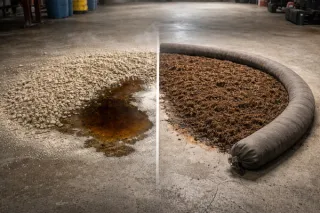
• Socks, pillows, and booms are reusable containment tools. Their job is to block flow, protect drains, and control movement. They remain reusable until fully saturated.
• Granular absorbent removes the spill. Its job is to pull oil and fuel off the surface and leave it safer and cleaner.
Containment prevents escalation. Granular absorbent completes the cleanup.
The 2-Step Spill Response Professionals Use
This approach works for small drips and major spills alike.
Step 1: Contain the Spill (Socks, Pillows, or Booms)
Containment is about control. Oil and fuel spread fast, move downhill, and head straight for drains.
Use socks, pillows, or booms to:
• Circle the spill
• Block doorways and traffic lanes
• Protect storm drains and trench drains
• Catch recurring leaks under equipment
• Create barriers on sloped surfaces
Reusability matters:
If containment tools are not fully saturated, they should be reused. Many facilities leave them staged or in place for ongoing protection.
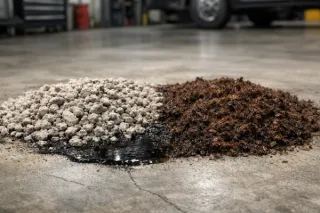
Step 2: Absorb and Finish (Granular Absorbent)
Once the spill is contained, removal begins.
Use granular absorbent to:
• Soak up pooled oil or fuel
• Pull liquid out of concrete pores and texture
• Reduce slip hazards
• Finish the surface safely
Key cost-saving advantage:
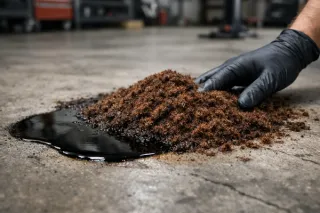
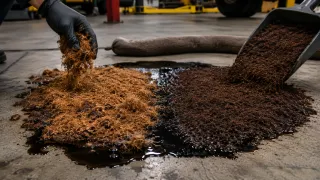
When applying granular absorbent, only the fibers that contact oil or fuel become waste. Clean, unused plant fibers remain reusable and can be swept up, separated, and saved for future use.
SaveSorb is a plant-based absorbent that is hydrophobic and oleophilic. It repels water and aggressively binds to hydrocarbons, encapsulating oil and helping reduce disposal volume.
Learn more at https://savesorb.com/
Quick Decision Guide
If the spill is moving or spreading
Use socks, pillows, or booms immediately.
If there is a drain, doorway, or slope nearby
Contain first, then absorb.
If the spill is small and stationary
Granular absorbent may be enough.
If the spill is large or recurring
Use both and reuse containment until saturated.
If the spill is outdoors
Contain aggressively before absorption.
Granular Absorbent: Best Uses and Limitations
Best for:
• Shops and garages
• Fleet yards
• Warehouses
• Job sites
• Final cleanup after containment
Limitations:
• Not a physical barrier
• Ineffective alone on slopes or flowing spills
Granular absorbent performs best when containment is used first.
Absorbent Socks: Reusable Control at Ground Level
Absorbent socks are flexible, fast-deploy containment tools.
Best uses:
• Perimeter control
• Doorways and edges
• Drip lines
• Traffic lanes
Socks are reusable multiple times until saturated, making them ideal for recurring leak zones and preventive placement.
Absorbent Booms: Higher Capacity, Still Reusable
Booms are larger containment tools for higher-risk areas.
Best uses:
• Drain protection
• Outdoor yards
• Larger spill zones
• Environmental protection
Booms are reusable until saturated and should not be discarded after a single use.
Pillows and Spillow Mats: Reusable Preventive Protection
Pillows and Spillow mats are ideal for:
• Under leak-prone equipment
• Beneath parked vehicles
• Tight spaces
• Preventive placement
They are not disposable pads. They remain reusable until fully saturated and often stay in service long-term.
Common Mistakes That Increase Cleanup Costs
-
Skipping containment
-
Pouring granular absorbent in one pile
-
Not working absorbent into rough surfaces
-
Ignoring drains and slopes
-
Using the wrong absorbent
-
Leaving slick residue behind
-
Discarding reusable socks, pillows, mats, or clean fibers prematurely
Best Spill Kit Setup
Service trucks:
• Reusable socks
• Granular absorbent
• Gloves and waste bags
Shops and fleet bays:
• Socks near lifts and drains
• Granular absorbent for finishing
Warehouses:
• Socks or booms at doors
• Granular absorbent for forklift leaks
Outdoor yards:
• Booms for drains
• Socks for control
• Granular for removal
Bottom Line
Professional spill response is about using the right tool at the right time and reusing what still has value.
Contain first with reusable socks, pillows, or booms.
Absorb second with granular absorbent.
Reuse clean plant fibers and containment tools until saturation.
This system reduces waste, lowers cost, improves safety, and keeps cleanup predictable.
Upgrade your spill response at https://savesorb.com/
Spills will happen. The difference is how fast you control them and how smart you manage the cleanup afterward.